

Can ChatGPT do a build takeoff? What Generic AI Does — and What It Can't Do
A takeoff is reading symbols, measuring to scale, counting exhaustively over hundreds of pages, and managing addenda that arrive at the wrong time. It's visual, spatial and cumulative work — not word processing. That's exactly why ChatGPT is hooked.
What a takeoff actually does
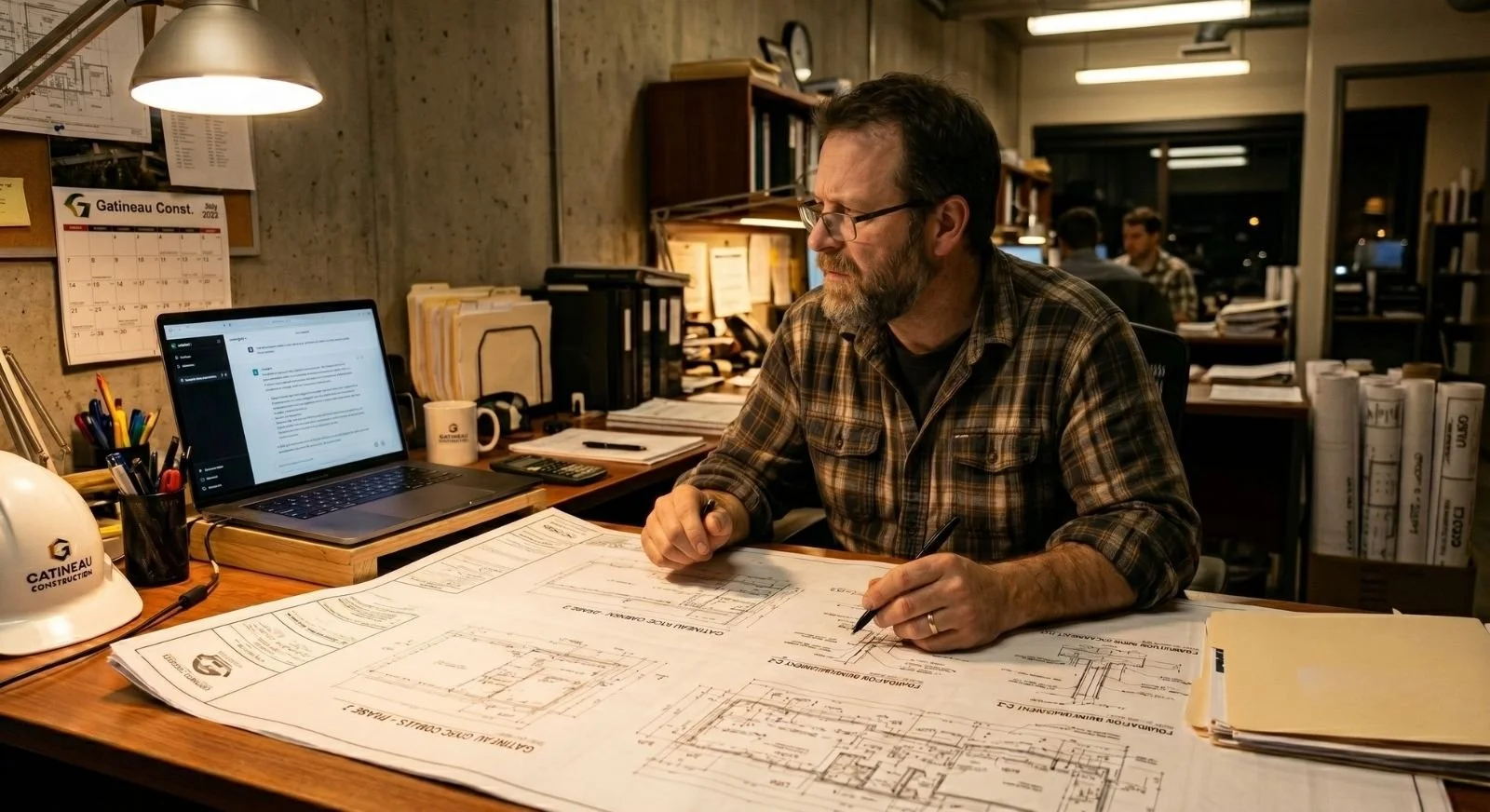
A takeoff is reading symbols, measuring to scale, counting exhaustively over hundreds of pages, and managing addenda that arrive at the wrong time. It is a visual, spatial and cumulative work. Not word processing.
What makes this work demanding is precisely what makes it difficult to delegate to a generalist tool. Reading a legend specific to a specific architect, maintaining a consistent count across 200 sheets, returning to a sheet when an addendum changes an area already dealt with — these are tasks that require procedural rigor, not general intelligence. That's exactly why ChatGPT is hooked on this.
Why ChatGPT can't do a takeoff
| Capacity | ChatGPT |
 Specialized tool
|
|---|---|---|
| Periphery of the estimation work | ||
| Write emails and cover letters To subcontractors, to customers, by call for tenders |
✓ |
✓ |
| Summarize a quote or specifications Identify unusual clauses, special requirements |
✓ |
✓ |
| Unit conversions and basic formulas Square Feet, Linear Meters, Quick Calculations |
✓ |
✓ |
| Heart of the takeoff | ||
| Read the document-specific caption Adapting to the conventions of each architect |
✕ |
✓ |
| Detecting symbols on technical plans Electrical, mechanical, structural, architectural |
✕ |
✓ |
| Measure to scale on a calibrated plane Conversion factor applied sheet by slip |
✕ |
✓ |
| Process a complete set of 50 to 400+ slips Consistency of the count across the entire volume |
✕ |
✓ |
| Traceable quantities per slip and per field Each element detected is visible and validable |
✕ |
✓ |
| Work on scanned or low-resolution plans The reality on the ground, not just clean documents |
✕ |
✓ |
| Canadian Hosting — Bill 25 Compliant Protected project data, controlled access |
✕ |
✓ |
A language model treats images as generic visual data. He can describe what he sees, sometimes impressively, but he has not been trained to read technical symbols with the rigor that a takeoff requires. If you submit an electrical plan and ask him to count the electrical outlets, he will give you a number. This figure will often be approximate, sometimes wrong, and you will have no reliable way to validate its method or know which symbols have been included or excluded. In a bid, untraceable quantities represent a direct financial risk.
Besides, he does not know the legend of your plans. Each game has its own conventions, and some architects have symbol systems of their own. ChatGPT doesn't have the mechanism to adapt to a particular document — it works with what it knows in general, not with what your caption specifically defines. A specialized tool learns the caption of the document and applies it consistently from one sheet to the next.
It doesn't measure to scale either. Calculating linear meters on a plan means reading the scale of the document, applying a conversion factor, and maintaining this consistency on each sheet. It is a geometric operation on a calibrated document. This is not what language models are built for.
Not to mention the fact that it doesn't keep up for hundreds of pages. A complete set of blueprints can contain 50, 150, sometimes more than 400. Processing each sheet, attaching each element to the right area or level, making sure that no element is counted twice, is structured data management over a large volume.
The difference between an LLM and a tool trained on construction plans
A specialized takeoff tool for construction works on a different principle. He is specifically trained to detect visual patterns in technical documents: electrical symbols, windows, structural columns, mechanical systems.
The practical difference is reliability and traceability. You can see which symbols were detected, on which sheets, with which classification. You can validate, you can correct. It's a tool that works for you.
This traceability is essential in a professional context. A bid is based on defensible quantities — in front of a client, in front of a subcontractor, or in front of your own team if the project is not going well than expected.
What this means for estimators evaluating tools right now
A serious tool adapts to your documents, not the other way around. A tool built for construction reads the caption of your specific document and adapts to it. On architects' plans that have their own conventions, this is where the performance gap becomes concrete.
The quality of the documents is also a revealing test. Scanned plans, low-resolution PDFs, misdirected leaflets — that's the reality on the ground. A tool that only performs on clean documents will let you down at exactly the wrong time.
Traceability is what protects you professionally. Being able to see exactly what was detected, on which sheet, with which classification — this is what allows you to validate, correct, and defend your quantities. Without it, you have a figure without a method, which is no more valuable than an estimate made blindly.
Finally, Canadian hosting and compliance with Bill 25 are not administrative details. Your project data is sensitive. Where it is stored and who has access to it matters, especially in a context where public contractors are starting to ask these questions themselves.
