The Modern Construction Site: How AI Transforms Construction Work, From the Office to the Field
In recent years, there has been a lot of emphasis in the industry on technologies for the field. On some construction sites, sensors are emerging to optimize the use of equipment, drones to monitor progress, 3D modeling tools and real-time monitoring platforms.
These innovations have their place, but their impact remains limited as long as the upstream processes remain fragile.
In fact, many construction contractors say it: a project gets on track before the site begins. In the field, we execute and adjust; but it is in the office that the conditions for success are prepared.
The modern construction site begins in the analysis of plans, information management, coordination, estimation and decision-making. This is often where everything gets complicated: information is lost, discrepancies accumulate, hours disappear in tasks that do not bring value.
This administrative burden ends up dictating the fluidity of the project in the field — and this is where AI brings its most concrete impact.
After working with many contractors, estimators, project managers and administrative managers, one truth is clear: the modern construction site is not just about new tools. It's a better managed project because the teams in the office finally have a structure that eliminates friction.
Estimating moves faster when repetitive work disappears
Estimating remains a fundamental step for any construction company. The work requires precision, but time is lacking. Files arrive loaded, changes are added, and the pressure mounts as the deadline approaches. In this context, even the most experienced estimators feel the weight of the process. Each submission becomes a sustained effort where error can occur, not through lack of skill, but through overload.
It only takes one common scenario to understand this reality: an appraiser receives an addendum the day before filing. Forty pages to review, quantities to adjust, and no margin for error. It is not the judgment that is lacking, it is the time.
AI is now able to lighten what takes time. The analysis of the plans is the clearest example of this. Extracting quantities, identifying elements, going through dozens of pages to identify essential components represents a constant burden. Today, AI is able to automatically recognize a wide variety of symbols on plans. In many cases, the AI can prepare up to 90% of the statement, to be validated by the estimator.
Thanks to AI, the estimator arrives in front of a pre-structured file that he or she simply needs to validate, adjust and interpret. All of this gives time to really analyze the project and make better decisions.
Finally, the structure of the form remains one of the most risky elements. Transcription errors, omissions, or misplaced quantities can tip a bid. The AI analyzes the entire file, proposes a structured form, identifies inconsistencies and facilitates the final check. This rigor reduces revisions and removes a huge part of the doubt that comes with the days leading up to the submission of a bid.
Project management that avoids slippage
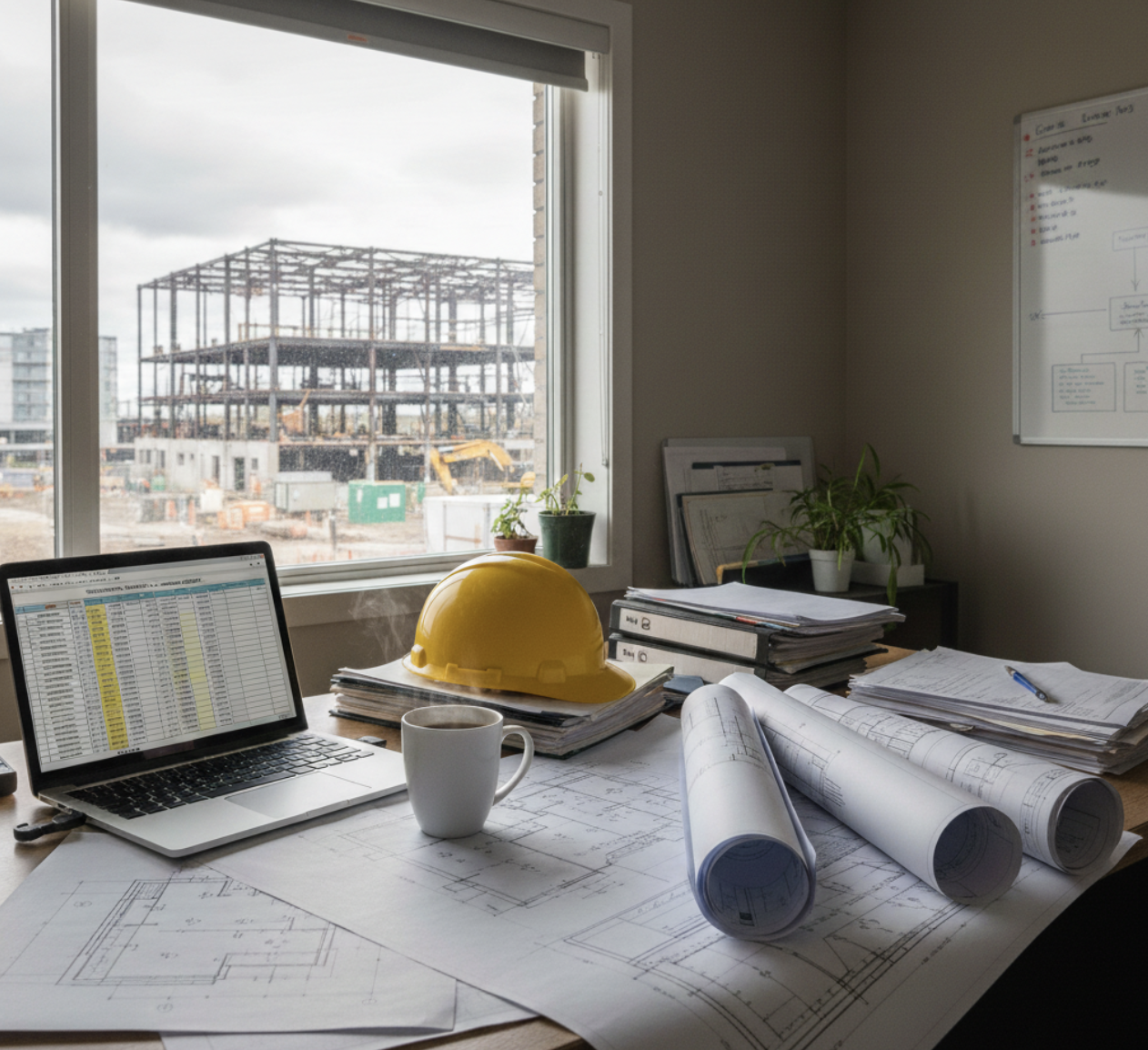
Project management involves a significant amount of information to be consulted and validated. In a file, plans, specifications, communications and technical notes accumulate quickly, and this dispersion of information is detrimental to the continuity of the work.
By indexing all the documents in a project, AI provides instant answers to questions that once required a lengthy search. A particular clause, a forgotten requirement, a note stipulated in a specific section of the quote, a change made in a previous version: the information is accessible in a few seconds, uniform and easy to validate. Workflow becomes smoother and decisions are made sooner, with more certainty.
AI also ensures the continuity of the project between colleagues, without having to dissect the ways of doing things or validate the work that has already been done. When a file changes hands, it often takes several hours or even days to dive into the documents, understand the logic used by the previous person and resume coordination without slowing down the project.
AI makes this transfer much simpler. It summarizes complex sections, highlights critical points, clarifies decisions already made, and presents all information in a uniform way, without omissions.
It is precisely this combined effect that represents the greatest contribution of AI: a massive reduction in forgetfulness. An oversight in a construction project inevitably creates consequences on the construction site. AI spots inconsistencies, highlights ambiguous sections, highlights unaddressed areas, and provides an objective look at the case. The project manager remains in control of the decisions, but he or she has constant support to avoid blind spots.
A simple administration is an administration that works
" The administration has never lacked competence, it lacked space. AI frees up this space. And when the noise disappears, we finally see the project as it is. It completely changes the quality of administrative work."
The administration is often the invisible part of a project, but it is the backbone of it. Without solid document management, constant monitoring, and rigorous information transmission, even the best field teams can find themselves slowed down.
In this case, AI provides the power to generate meeting minutes from discussions, prepare letters of intent, summarize customer interactions, file documents received, and offer pre-filled versions of forms. The objective is not to replace humans in their communications, but to offer a clean, coherent basis ready to validate. This time saved translates into a reduction in the pressure that comes with everyday life.
AI also contributes to the extraction of contractual information. A quote contains dozens of nuances, and each project hides its particularities. This work requires constant attention, often to the detriment of other more strategic tasks. By going through the document as a whole and isolating what deserves validation, AI brings order to a process that quickly becomes chaotic.
Accounting and administrative work can also benefit from AI. Detecting errors in invoices, organizing supporting documents, automatically classifying documents or preparing data for claims becomes faster and more reliable. The administrative team retains its essential role of control and validation, but it is freed from repetitive tasks that slow down its days.
AI is becoming an essential lever in construction
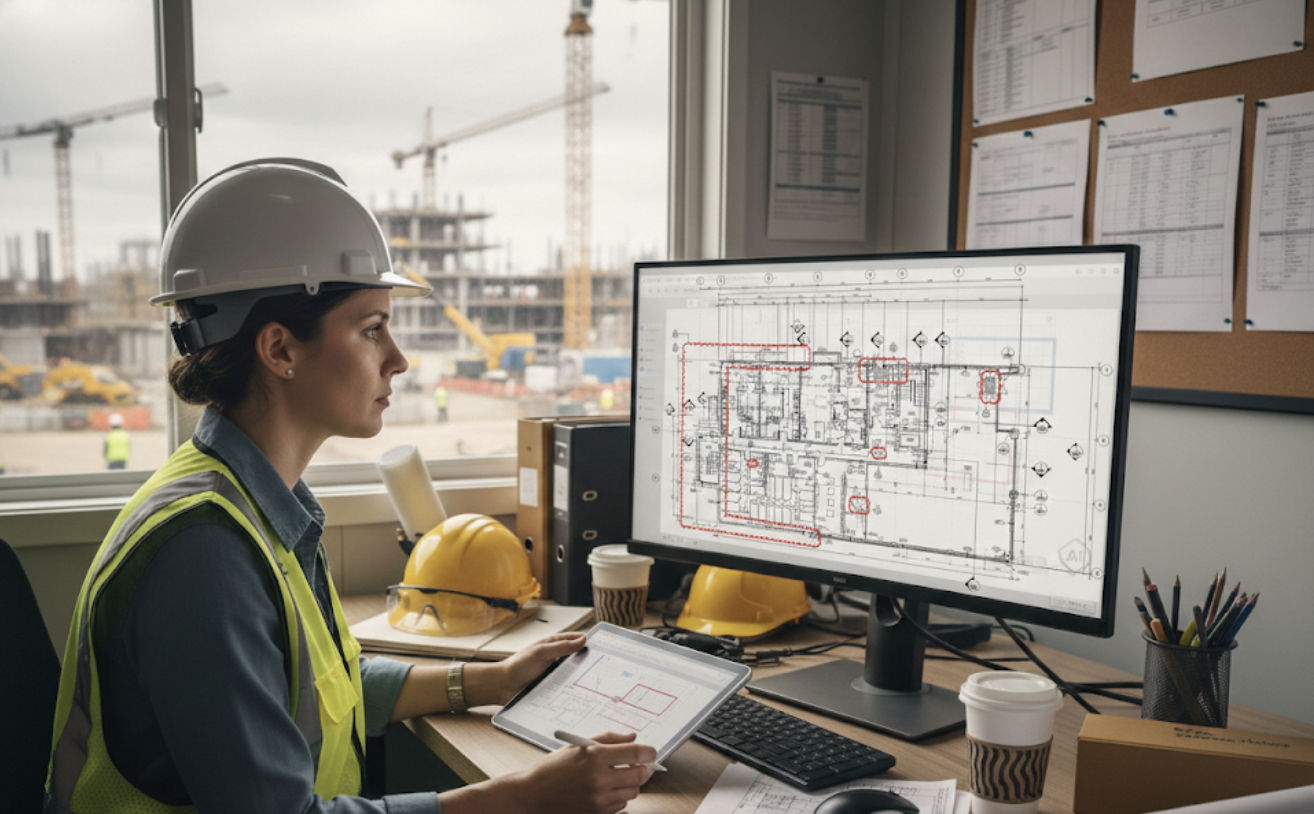
The impact of AI on the modern construction site is not what you might expect. It does not come from robots or futuristic technologies, but rather from a better flow of information.
The modern construction site does not need a technological revolution, but rather to target the processes where AI can bring operational efficiency.
When the office works better, the construction site naturally becomes smoother. Decisions are made earlier. Risks are better controlled. Communications are clearer. The teams no longer have to compensate for administrative problems that could have been solved upstream. Finally, the irritants that have been slowing down teams for years can finally be alleviated. AI does not change the profession; it improves the conditions.
In a context where margins are tightening, labour is scarce and deadlines are compressing, AI is becoming an essential lever. Organizations that adopt these tools develop a maturity and productivity that becomes difficult to catch up.
They improve their estimating capacity, increase the rigour of their projects, speed up communications and reduce operational stress. While the most visible gain is productivity, the most significant gain is control and mastery of projects.
The modern construction site is built first and foremost in information

The future of construction is not only played out on the ground. It is played out in the office, where AI empowers each team to move faster, with more clarity, and with more confidence. AI is transforming construction by giving time, certainty, and control back to professionals.
At Explorai, we support companies that want to take this step without disrupting their methods. Our approach is based on concrete projects and solutions adapted to the reality of the teams, whether they are specialized tools such as Estim.ai or AI assistants capable of structuring information and supporting teams in their critical tasks.